The battle for audience attention (2): why stay awake in conversation?


Yesterday's televising of Supreme Court proceedings got me thinking about my attempts to use recordings to study courtroom language - and how conversation analysis had led my later works to focus on public speaking and presentation more  generally. 

This is a continuation of yesterday's excerpt from 'Lend Me Your Ears':

… becoming an effective public speaker depends on having as clear a picture as possible of the key differences between conversation on the one hand, and speeches and presentations on the other. The most important of all of these is the dramatic change in our motives for paying attention that occurs as soon as we stop conversing with other members of the audience, and settle down to listen to the speaker of the day. When I ask audiences if any of them ever find it difficult to stay awake during speeches, presentations, lectures or sermons, a typical result is that 100 per cent of them put up their hands. When asked how many have trouble staying awake listening to what someone is saying during conversations, the typical result is zero per cent.

The first statistic is proof that everyone knows that speeches and presentations have a tremendous capacity for boring audiences out of their minds, and that holding the attention of an audience is a major challenge for speakers. The second statistic points to something that people know when they think about it, but probably never give much thought to most of the time: most of us have little or no trouble in staying awake while engaged in conversation with a small number of others. This is because there are powerful incentives to pay attention built into the way conversation works. And these incentives are underpinned by implicit
rules that are not written down and formally taught, but are understood by everyone capable of having a conversation.

One at a time
The most obvious feature of conversation is that we take it in turns to talk: one speaker says something and, when that one’s turn comes to an end, a next speaker starts, and so on until the end of the conversation:

Speaker A: ——————|
Speaker B:                       |——————|
Speaker C:                                             |———————|

If someone else suddenly starts speaking when you are still in the middle of your turn, it’s natural to feel annoyed. In fact, you’re likely to regard anyone who trespasses on your space as ‘rude’ or ‘impolite’. You are not only within your rights to complain, but are equipped with the necessary vocabulary for referring to the
misdemeanour: the words ‘interrupt’ and ‘interruption’. When you complain of being ‘interrupted’, you are actually drawing attention to the fact that a basic, though implicit, rule of conversation has been broken: only one speaker should speak at a time, and others in the conversation should wait until the end of any current turn before starting the next one.

Occasional failures to observe this rule may be tolerated, but anyone who makes a regular habit of starting to speak in the middle of other people’s turns soon finds that there’s a heavy price to pay. Your reputation will go into a nosedive. At best, you’ll be regarded as impolite or inconsiderate; at worst as a pushy, domineering
control freak who’d rather ‘hog the conversation’ than listen to what anyone else has to say. If you’d rather not be seen like this, you have a strong incentive to pay attention at least closely enough to know when the previous speaker has finished, and when you can launch into a turn of your own without being accused of interrupting.

Coming in on cue
The incentive to listen during conversations isn’t just a matter of paying close enough attention to notice when a speaker gets to the end of a turn, as there is another rule about when you can start the next turn. Fail to get this right, and people will have another reason for wondering about your manners and motives. You only
have to think of how you react if, after greeting someone with the turn ‘Good morning’, the other person doesn’t reply at all.

Charitable explanations are that they must be half asleep, or perhaps a little deaf. But you’re much more likely to start worrying about why they aren’t speaking to you, what you’ve done to offend them or what’s gone wrong with the relationship. So the only way to stop other people from thinking such negative thoughts about you is to make sure that you start speaking before the silence has lasted long enough to be deemed ‘awkward’ or ‘embarrassing’.

This raises the question of just how long you’ve got before the silence starts to make things difficult? The answer is that you can’t afford to let the silence last for more than a split second. Research into conversation shows that silences of less than half a second are not only long enough to be noticed, but are enough to start us thinking that some kind of trouble is on its way. Studies of how people respond to invitations, for example, have found that an immediate reply usually means that the speaker is about to accept, whereas a delay of even a fraction of a second means that a refusal is on its way. The same is true of the way people reply to offers of various kinds: positive replies start straight away, and negative ones are delayed. So the safest way of preventing people from getting the wrong impression is to pay close enough attention to be able to start speaking as soon as possible, and certainly before the silence starts to get embarrassing.

Showing you were listening
Another extremely important reason for listening in conversation is that you have to be continually at the ready to say something that relates directly to what was said in the previous turn. Even a small lapse in concentration can cause you to say something that leads the previous speaker to conclude that you had not been paying attention, are not in the least bit interested in what they were saying, or that you are just plain rude. It often prompts accusations, arguments and conflict – so much so that it may well be at the heart of large numbers of domestic rows. If these could be traced back to their original source, many of them would
surely be found to have started just at that moment in a conversation when one speaker says something – or perhaps says nothing – that gives their spouse or partner the impression that he or she had not been listening.

The threat of having to say something
Conversational success and failure obviously depend on our continually maintaining a very high level of attentiveness to what others are saying. We have to keep listening closely enough not to interrupt, closely enough to come in on time and closely enough to be ready to say something that relates to the previous turn. In short, the ever-present threat that we might have to speak next amounts to an extremely powerful incentive for us to stay alert and wide-awake during a conversation. It also points to a fundamental reason why audiences will be in a very much lower state of attentiveness when listening to a speech or presentation.

(To be continued with 'Why audiences fall asleep')

The battle for audience attention

A general view shows Court One during the opening of the Supreme Court of the United Kingdom in London, October 16, 2009. REUTERS/Gareth Fuller/Pool


History is being made today with the televising of court of appeal proceedings.

And about time too is my reaction, because the prohibition on video and tape-recording in courts once stood in the way of my attempts to study court-room language. American colleagues had no problem in assembling large collections of tape-recorded hearings - and were generous enough to supply us with copies - on which, more HERE.

My interest in working out what turned jurors on and off led me to start recording political speeches and to focus on bursts of applause - as clapping was fairly concrete evidence that listeners were not only awake but also approved of what had just been said. This led to publication of a book that was to take my life in a different direction - and, later on to books aimed at showing people how to use what we had learnt about the main techniques in their own speeches and presentations.

So, to mark the day when I ought to be thinking about collecting video-tapes of court of appeal proceedings (but probably won't), I thought I'd post the beginnings of what became of some of the original research when applied to speaker-audience interaction more generally - from Lend Me Your Ears, Chapter 2...


The Battle for Audience Attention
Keeping Listeners Awake and Engaged

Most of us find it easy enough to discuss aspects of our life or work with one or two colleagues, friends, or even with complete strangers. But it’s a very different story when it comes to standingup and talking about the same subjects to an audience. Confident communicators suddenly find themselves crippled by nerves, the normally articulate sound muddled and confused, and enthusiasts for their subjects come across as dull, boring and monotonous. You will almost certainly have seen this happen. It may even have happened to you – but you may not be quite sure exactly why
it happens.

This difference in our level of confidence and effectiveness, depending on whether we’re speaking in a conversation or to an audience, is so great and so debilitating for so many people that it demands an explanation. The chapters in Part I set out to provide an answer by showing that there is what amounts to a ‘language of public speaking’. Less complicated and much easier to learn than a foreign language, it involves subtle deviations from everyday speech that can make life difficult for anyone who isn’t fully
aware of them. Knowing what these deviations are is an essential
first step towards understanding and mastering the techniques of
effective speech-making.

Different ways of speaking
Speaking in public is obviously different from just about any other form of communication we ever get involved in. The sense of unease experienced when making a speech or presentation tends to be accompanied by a vague realisation that our normal, everyday style of speaking doesn’t seem to be working in quite the way we expect. Speaking to an audience seems to require skills otherthan those that serve us so well during the rest of our talking lives. The trouble is that it’s not always immediately obvious what these are, or why our normal resources are failing us. This is why we can find ourselves, often good communicators in every other way, struggling and bewildered against the tide of polite indifference washing over us from an audience who would clearly rather be somewhere else.

One reason for this is that our ability to speak is something that we have taken for granted since infancy. Speaking to an audience requires different skills from those that serve us so well during the rest of our talking lives.  The trouble is that it is not immediately obvious what these are, let alone why our normal resources are failing us.

Apart from academic researchers who specialise in the study of talk, hardly anyone ever gives much thought to the detailed mechanics of how speech works. Most people’s technical understanding of conversation is similar to their technical understanding of what’s involved in riding a bicycle. Both are things we can do, without so much as a second thought, but the basic principles of how to do them are far from easy to put into words.

An ability to use language is often cited as the crucial factor distinguishing humans from other animals. But it is probably more accurate to say that the crucial factor is an ability to converse – and it’s more than mere ability. As conversationalists we are absolute experts. We listen, we understand, we contribute, all within fractions of a second. And we’re able to do this because
we start learning to converse from the moment we make our first sounds.

The type of speech we first learn as infants is conversation. As we grow older, it is the speaking skills of conversation that we spend most time practising and developing. In effect, we become specialists in conversational techniques, and it’s as conversationalists that we spend the vast majority of our talking lives. Only very occasionally do we have to speak in ways that are clearly different from conversation, such as in classrooms, courtrooms, places of worship, interviews, meetings, debates, speeches or presentations. As narrow specialists in conversation, it’s hardly surprising that we feel so uneasy when we have to speak in these less familiar situations. Nor is it surprising that the few who do develop these more specialised speaking skills – such as teachers, lawyers, politicians or clerics – come to be viewed as (and paid as) professionals....(to be continued).

Majorspeak revisited?


Regular readers will realise why, given my regular posts on the peculiar times and places selected by today's politicians (see below), I was greatly frustrated by yesterday's news headlines being dominated by a former Conservative prime minister making what the Daily Mail described as a 'wide ranging and passionate speech' to a real audience in a suitable location - without any media camera crews being present.

So you can't see it on YouTube or anywhere else, and, for once, all we can do is look at are those parts of it that were quoted in the media, such as this from the Daily Mail.

Improved mastery of rhetoric and imagery?
Compared with what I wrote in 1993 ('Majorspeak: observations on the prime minister's style of speaking'), some of which is touched on in the above video clip, there was some evidence that his command of rhetoric and imagery has improved - probably because of his experience on the lucrative US speaker circuit in the years since he left office.

There were, for example, some impressive contrasts:
"Governments should exist to protect people, not institutions"

The Conservative Party "is at its best when it is tolerant and it is open and at its worst when it's hectoring and censorious"

He said it was wrong that so many families would have to choose between keeping warm and eating this winter.

There was at least one three-part list in which the third item contrasted with the first two:
"and it is very easy, criminally easy, to overlook these silent citizens, they don't demonstrate, they don't make a fuss, they just get in with their lives.

There was a puzzle with a 3 part list in the solution":
"How do I know about these people? Because I grew up with them. they were my neighbours, the silent have-nots."

He also made some interesting use of imagery:
"If we Tories only navel gaze and only pander to our comfort zone, we will never win general elections. All the core delivers is the wooden spoon."

Majorspeak revisited?
An observation at the time of the 1992 general election was John Major's tendency to speak very 'formally' (See Chapter 19, Crew & Gosschalk, 1995). This was evidenced partly by his choice of words that are rarely, if ever, heard in everyday conversation (e.g. 'whomsoever', 'wayside inn', 'on the morrow', badinage, etc.) and partly by his reluctance ever to use the elided forms for negatives and certain tense constructions (e.g. he was more likely to say 'we do not' than 'we don't', 'we had' rather than we'd' etc.

In yesterday's speech, "hectoring" and "censorious" suggest that his preference for obscure words lives on.

But the fact that he said "they don't" twice in quick succession is perhaps evidence that he has started to break away from his former preference for using the full forms. 

The bad news is that, without the video-taped evidence, we may never know.

Related Posts:

How does Jeremy Hunt (or anyone else) know how many old people in the UK are 'chronically lonely' ?


It can hardly have passed anyone's notice that one of the big media stories over the past few days has been Health Secretary Jeremy Hunt's claims about the number of our aged population who are 'chronically lonely' (see above clip).

For me, his casual use of statistics brought back a vivid memory from more than forty years ago of an event that had made me deeply skeptical about the validity of treating such numbers as 'hard facts'.

Tony Benn sets up a research fellowship
A not so well-known fact about my early research is that I once held a Post Office research fellowship that had been created by the then Postmaster General, Tony Benn, at the University of Essex - which led to my conducting a survey of just over 1,000 randomly sampled respondents in the UK who were aged 65 and over.

In those pre-privatisation days, the Post Office (GPO) still ran our telephone system and Harold Wilson's Labour government was under pressure to supply free telephones to the country's elderly. But then, as now, research into a problem is always a much cheaper option than doing anything about it.

Mr Benn was a friend of Professor Peter Townsend, who was already well known for his definitive books on isolation in old age and who had just become the first head of sociology at the new University   of Essex. So that's where the money for the GPO research fellowship went - and, as a lowly research assistant, I was in the right place at the right time to be lucky enough to get the job.

'Objective' and 'subjective' isolation
Townsend and other researchers in the area had distinguished between two types of isolation:

  1. Objective: How often did respondents see their family and friends?
  2. Subjective: How many respondents said they felt lonely?
In the questionnaires, the second of these was measured by asking respondents: "Are you often, sometimes or never lonely", to which the results came out as remarkably similar from one survey to another*. For mine, if memory serves me correctly, the results were:
  • Often lonely: 7%
  • Sometimes lonely: 23%
  • Never lonely: 70%
So, by lumping "sometimes" and "often" lonely together, we could conclude that just under one in three elderly people experienced a degree of loneliness.

BUT...
While piloting the draft questionnaire, I interviewed an 80 year old woman who quite severely disabled and more or less housebound. She had no trouble answering the key questions with an immediate and emphatic "Never lonely"

As I packed away her completed questionnaire in my bag and explained that I had to be going,  she begged be to stay a bit longer, and launched into a series of sad stories about relatives who never came to see her and about how her  disability prevented her from going to see the few of her friends who were still alive. How could I refuse her insistence that I must have enough time for a cup of tea?

Yet the 'hard fact', already recorded in my questionnaire, was that she was one of the 70% who were "never lonely".

This contradiction between her answers to the question on the questionnaire and what she said over tea afterwards made gave me serious doubts about the validity of such apparently 'hard facts'. 

All these years later, thanks to Mr Hunt, the doubts have come back - and I'm no less suspicious of his 'hard facts' today as I was of my own 'hard facts' then. 

"Chronically lonely" sounds even worse than "very lonely" - which raises the question of whether more or fewer than the 7%  who confessed to being "very lonely" in 1967 would admit to being "chronically lonely" in 2013? Mr Hunt may have meant well by raising the issue with a wider audience, but to imply that such figures are 'hard facts' worth taking seriously is to assume rather a lot.

P.S. A missed opportunity?
It wasn't as if this experience were the only thing that had made me start questioning the methodology of what I was doing. It was at a time when important debates were getting under way in in academic sociology: quantitative research and survey methods were coming under attack from qualitative researchers; positivism, the hypothetico-deductive model of science and the collection of 'hard facts' were being challenged by approaches like symbolic interactionism, ethnomethodology and conversation analysis. And  Thomas Kuhn had just taught us the new phrase 'scientific paradigm'.

My own PhD research was already veering in this latter direction, as central theme was a critique of the paradigm established by Emile Durkheim's 1897 classic Le Suicide (eventually published as Discovering Suicide: Studies in the Social Organizatin of Sudden Death, 1978).

Meanwhile, one of my colleagues at Essex, Dorothy Smith had just heard from Erving Goffman at UC Berkeley that he had a rather promising graduate student called Harvey Sacks who was writing a PhD thesis based on live tape-recordings of telephone calls to the Los Angeles Suicide Prevention Agency, and even suggested that I might do something similar rather than the conventional survey research that was being planned.

Ignoring such excellent advice, I played safe by remaining loyal to the methodology favoured in Peter Townsend's books on the elderly and poverty. 

By the time I had finished my PhD, however, Sacks had put in quite an important appearance in my thesis. And later on, much of the motivation and inspiration for my later work on public speaking and presentation (books at the bottom of this page) came directly from him and the other main founders of conversation analysis, Emanuel Shegloff and Gail Jefferson.

P.P.S. The same results yet again
Less than 24 hours after posting this, I was fascinated to learn that a figure very close to the 7% saying they were 'often lonely' in my survey appeared in this bar chart, showing the percentage of 'over 60s reporting frequent loneliness' in the UK.

My thanks to @FlipChartRick for drawing my attention to his blog Flip Chart Fairy Tales, which featured the chart - and where you can read more comments about what Mr Hunt said.

Loneliness in Europe

Graphical domination of BBC TV News goes from bad to worse?

Huw Edwards - News at 10

For a while, you'll be able to enjoy, if 'enjoy' is the right word for a series of PowerPoint style presentations, last night's BBC News at 10 on iPlayer HERE.

It starts with a seated Huw Edwards reading out the headlines for about 1:30 minutes. Then, he reappears standing in front of a screen, where distracting dollar bills float into heaps in front of the Capitol in Washington DC behind him.

As he clutches a sheet of paper that doesn't seem to serve any useful purpose, numbers about what he's telling us start appearing behind him. Occasionally he makes as if to look at them before handing us over to their Washington correspondent.

Plenty more graphics follow until a flip chart suddenly appears at 14:41 minutes in, with people sitting behind it. But don't worry, our economics correspondent isn't going to write on it, as the numbers and words plop on to the chart, giving the game away just before she's had time to tell us the news about them.

Scroll on to 21:01 minutes, and Huw's back on his feet again with paper in his hands again and more pictures behind him again - soon to be followed by a series of bullet points zooming threateningly in behind his back.

But the barmiest sequence of all comes in at 22:25 minutes into the news, when our medical correspondent suddenly reappears in the middle of a series of concentric circles next to what could be some towers. And towers they turn out to be - tall enough to hold a list of 10 bullet points. As if that weren't enough, the next two towers are tall enough to accommodate 11 bullet points.

23:09 minutes in, we learn why the concentric circles are there. Our medical correspondent is actually standing in the middle of a pie chart, that starts whizzing around him as he tries to point out the numbers that have appears

Regular readers know that I've complained about the BBC's assumption that PowerPoint style presentations are just what viewers who've spent the day suffering from PowerPoint want to see in the evenings.

I've wondered about how much such expensive-looking graphics cost and whether the BBC ever does any research into how audiences respond to news that's presented in this way.

If so, it's surely time they published the results. If not, I'd be glad to offer my services...


Other posts on TV news via PowerPoint:


Cameron's speech: who thinks he should be seen pretending not to use a script?

It is very well-known that technology can have a marked impact on how effectively speakers come across to an audience - as anyone who's ever been at a PowerPoint presentation knows only too well (see also HERE).

So a matter, if not the matter,  arising from this year's party conference season is just how effectively do speakers come across when they pretend not to use a script?

Three 'scriptless' leaders
Because this year, we saw Ed Miliband repeating the feat of memory that worked so well for him last year, while Nick Clegg and David Cameron relied on huge teleprompter screens that were hidden towards the back of the audence - as did  George OsborneJeremy Hunt and no doubt a few others .

Of the party leaders, Miliband showed us that he could indeed do it again and Clegg showed us (as I've long suspected) that standing at a lectern works better for him than wandering about the stage like a management guru.

But Cameron was more disappointing than usual, not least because he's a talented enough public speaker, whether speaking from a script or from memory, not to have to rely on such gadgets. You don't have to watch very far into the above to notice that his head and eyes don't always move in time together: his head sometimes turns slightly while his eyes stay firmly glued to the screen directly in front of him - rather like some of Margaret Thatcher's problems when she spoke from Autocue screens.

Where is the advice coming from and what's the evidence for it?
As has often concerned me about the BBC's obsession with PowerPoint style news and current affairs coverage, what gave them the idea that audiences like it and can they point to any research that actually supports such a claim.

So for Messrs Miliband, Clegg and Cameron (and their aides), I have a similar question or two.

Who has advised you that it's a good idea to be seen to be pretending not to have a script and have they shown you any empirical evidence that supports their claim. If so, what is it and where can I see it?

If not, why on earth are you taking any notice of their advice?

(P.S. And some questions for Mr Miliband: who thinks it's a good idea to have some of the audience behind you and do they have any evidence to support their claim? If so, what is it and where can I see it? If not, why are you taking any notice of their advice?)

Related posts

Did George Osborne get away with reading his speech from the back of the hall?

Embedded image permalink

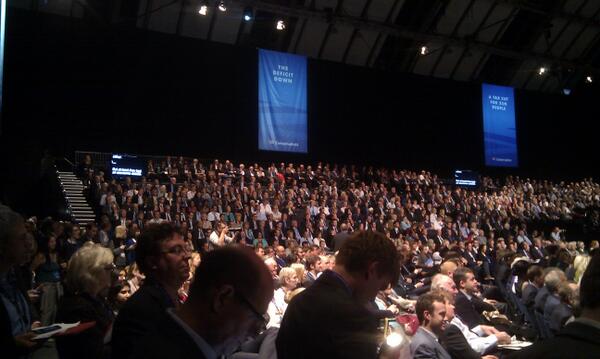
Gigantic screens at the back of the hall, big enough for speakers to read their scripts from, seem to be replacing more traditional teleprompters (like Autocue) this year.

The picture above was posted on Twitter earlier today by Paul Waugh during George Osborne's speech at the Conservative Party conference - and retweeted as follows by John Rentoul, who had presumably also noticed similar goings on at the Liberal Democrat conference:  

"Very Nick Clegg RT @paulwaugh: Autocues in the audience for Osbo speech.. Helpful for any soundbites we miss."

This raises at least two questions that our politicians might like to consider.
  • Do they really want comments on their latest gadgets to become a focus of attention for journalists?
  • Does this technological gadgetry help them to improve the delivery of their speeches?
The answer to the first of these questions is presumably "No" - unless, of course, they're quite happy about reporters being distracted away from the content of the speech.

And, on the evidence of today's performance by Mr Osborne, the answer to the second is also a resounding "No" (but you can judge this for yourself below).

As for why this should be, I suspect that the technology and/or the script aren't in place soon enough for the speaker to get enough practice at using it before making the actual speech itself - for which he, his aides and the gadget operators would all have to make extra time when the hall was deserted..'


Some related posts on teleprompters:

Lincoln the movie: 'too many words' and 'too American' for British ears?


Last night we went to watch the film Lincoln in our local village hall - and, as something of a speech and communications nerd, it was something I had been looking forward to for quite a while.
But, from a few minutes in, I found it increasingly difficult to get two rather negative thoughts out of my mind.

1. Too many words?
One was a memorable line from the film  Amadeus, when Mozart is confronted by the complaint that his latest composition suffered from having had "too many notes." From discussions afterwards, I know that I wasn't the only person in the audience who thought that Lincoln suffered from having "far too many words".

Among other things, this had the effect,  of making it the film too long. For example, when individual members of Congress started to vote on the crucial amendment one by one, I wondered just how many hundreds of these we were going to have to sit through.

2. Too American?
I'll admit that our village hall film shows do have a problem with the sound quality, so it was also a relief to learn afterwards that I hadn't been to only one there who had trouble hearing the dialogue. Leaving that to one side, however, there was something else that was difficult to get out of my mind -  that I'd implicitly touched on in a recent presentation on on how well does English work as a common language.

This was the fact that differences between American and British culture may have ensured that Lincoln was unlikely to impress British audiences as much it had apparently impressed audiences on the other side of the Atlantic.

Before the film started, another member of the audience had already said to me "I don't know much about American history and I've really only come because I felt I ought to - I might learn something."

Too Ethnocentric for a British audience?
And here lies the rub. We Brits really know very little about the history of the USA, let alone its constitution or how it works.

We do know that they had the audacity to declare their independence from us, that they had a civil war that led to the end of slavery - though not the end of segregation (HERE) - and that they had opted to have a president rather than a monarchy.

But most of us know very little about the separation of powers between the legislative and executive arms of government, nor about the differences between the individual constituent states of the USA and the federal government - or the machinations between them that this gives rise to.

So for us, some of the basic assumptions at the heart of the film were at best culturally strange and at worst, completely foreign to us.

Vices & virtue as drama?
Apart from the characters of Lincoln and his family, it was never really made clear who everyone else was and we were left guessing who they were and which side they were on, whether in the ongoing debate or the civil war itself. All too often conversations sounded more like a succession of speeches or soliloquies, as when Mrs Lincoln had a row with her husband.

But, however unrealistic, unclear or plain boring the script might have been to British-English ears, the superb acting of Daniel Day Lewis not only deserved  all the acclaim and awards that he received for it but was main thing that made it worth seeing at all,

Now we've had an Anglo-Irish actor making such an excellent job of playing a US president so soon after an American actress (Meryl Streep) apparently played a British prime minister (Margaret Thatcher) rather well, we may even be witnessing a promising trend that might actually bring our two cultures a bit closer together.

But that may depend on whether screen-script writers on each side of the Atlantic take note of the famous line that's widely attributed to George Bernard Shaw - England and America are two countries divided by a common language - but which he apparently never said...

Next open course on Speechwriting & Presentation. 10-11 October

Is it really 5 years since my blogging (or vanity) began?

Today this blog marks its fifth anniversary.  

Blogging hadn't really occurred to me until Michael Crick, then of BBC 2's Newsnight programme, and now at Channel 4 News, suggested to me that it might be a good idea.

I suppose he must have already known that the rise of the internet and social media, etc. had severely limited the chances of 'specialists' like me to get their output published in the mainstream media.

But I have to admit that it's rather a mixed blessing to be able to 'publish' anything you feel like writing without any kind of editorial comment, feedback or control..

A few of the 998 blogposts (so far) were based on material that had already appeared in newspapers. But the vast majority never did.

There was, of course, a time when to publish you own writings was referred to as 'vanity publishing'.

But a big difference between 'vanity publishing' and blogging is that this costs you very little other the hours you spend on it.

Whether or not it's proof of my vanity, I'll leave others to decide. To help on yout way, I've decided to mark the anniversary by putting links to old posts from the archives on Twitter - the first one of which outlined some tips for Gordon Brown's party conference speech in 2008.

Next open course on Speechwriting & Presentation. 10-11 October

How well does English really work as a 'common language' of communication?


(Script of my presentation at last week's European Speechwriters Conference).

This talk has been prompted by a number of experiences running courses on speechwriting and presentation in various parts of Europe.

Like some of my previous presentations at UK Speechwriters’ Guild conferences, it poses more questions than it answers. But at least it may open a discussion of possible interest and relevance to many of you here today.

All the courses on speechwriting were conducted in English

None of those attending was a native-speaker of English.

But all of them had the job of writing speeches in English, to be given by other non-native speakers of English to audiences of yet more non-native speakers of English.

We who have been native speakers of English since acquiring language in the first place (and who have little need to develop a command of any other language) cannot help being full of admiration for the fact that they can do it at all. But the challenge they face brings three true stories to mind, and raises at least three questions worth discussing.

Speaking to non-native speakers (1) 
The first time I ever spoke to an audience of non-native speakers of English was more than three decades ago at an academic conference in the Council of Europe chamber in Strasbourg.

It was long before I'd developed a technical interest in how audiences react to public speaking. when my main experience had been listening to academics read out papers at other academic conferences.

I was to present a 30 page academic paper, for which I had been allocated 5 minutes.

So I decided (very unwisely) to read it aloud as quickly as possible and see how far I got - which wasn't very far. After about half a minute, the chairman interrupted me. 

The  simultaneous interpreters had complained that they couldn't keep up with me speaking at such a pace, so he asked me to slow down.

Speaking to non-native speakers (2) 
Later on, at another academic conference at the University of Konstanz, I could tell that my audience was looking increasingly puzzled by what I was saying.

By then, I had become a bit more sensitive to the needs of my audience and came up with what might have been a suitable strategy: simplify, simplify, simplify.

Suitable strategy it might have been if only I hadn't use more colloquialisms and slang to 'simplify' my points. And that, of course, was no solution at all, as it made my talk even more unintelligible to the audience than it had been in the first place.

Speaking to non-native speakers (3)
In the third example, I wasn’t actually speaking but was in an audience of mixed,  nationalities, mainly from Europe, at a conference in Urbino.

It was a memorable lecture analysing a letter by Pliny the Younger by the well-known semiologist and author, Umberto Eco - though memorable more for what happened than for what he said.

He had just started his lecture when a group of locals demanded to know why he was speaking English in an Italian university. His response was impressively democratic and he asked the audience:

“How many of you can only speak English?”

I was one of the tiny minority of 5 or 6 native speakers of British and American English who raised their hands.

In response to which Eco quickly rephrased his question:

“For how many of you is English the only foreign language you can understand?”

The vast majority of hands now went up, to which Eco turned to his compatriots and said:

As my lecture was advertised to be in English and the only language most people here understand is English, I shall give my lecture in English” – at which point, the rebellious Italian minority walked out.

Lingua Anglica
So, although English may have become Europe’s new Lingua Franca its dominance is not always without its problems.

Speaking more quickly and simplifying via colloquialisms and slang are obviously no solution.

And there is quite a lot of good news. For one thing, the same rhetorical techniques are just as effective in getting messages across in any particular language – and have been for at least 2,000 years since the classical Greeks began teaching and writing about rhetoric.

For example, I remember when writing Our Masters Voices, Francois Mitterand had just been elected President of France – and the one line that was widely quoted in the British media was a poetic contrast with alliteration.

In English his aim was translated as: “My aim will be to convince, not to conquer.”

The original French version must have arguably sounded even more poetic, with its simple rhyme:
á convaincre, pas Ã¡ vaincre." 

Stories & imagery
Nor is it just rhetorical techniques like contrasts and three-part lists that work effectively to get messages across in any language. The same is true of using stories or anecdotes to illustrate your key points.

Other forms of imagery can also work effectively in any language, but metaphors do sometimes need handling with care, especially in the case of sporting metaphors.

As a native speaker of British English, I often find myself bemoaning the fact that we have imported so many baseball metaphors from American English,  even though it’s not a game that's played or understood by most British adults.

But that doesn’t stop us having to listen to fellow British presenters telling us about “Going up to the plate” or “getting past first base”.

Cricketing metaphors may be fine for speakers of English in Australasia, the Caribbean or the Indian sub-continent, but they're not much use in  the USA, or indeed in the rest of Europe.

What do they really mean?
All of which brings me to some rather obvious questions, about which I'm curious, but to which I have no obvious answers.

Although English is so widely spoken around the world, how well is it actually understood?

Or, going back to my opening comments, how effectively are non-native speakers of English who give speeches written by other non-native speakers of English to audiences of yet more non-native speakers  of English?

I used to do quite a lot of work with the director of communications at a British company that had recently been taken over by a Dutch company.

When I made some remark about how lucky they were that the Netherlands was part of the English-speaking world, he replied:

“Yes, their English is very impressive – but there are times when we’re not quite sure whether they’ve really got the point.”
  
The crunch question
It was a similar story from a Japanese student in Oxford who was studying for a PhD.

As she had spent many of her teenage years growing up in the USA, she was fluent in Japanese and English, which enabled her to pay for her studies by doing simultaneous translation at high level business meetings.

After one such meeting between Japanese and British motor manufacturers, I asked her how it had gone – to which she replied:

“OK as far as it went, but I do think that they should pay me for an extra hour after the meetings so I could tell them what I think they really meant.”

Her point, of course, was that the simultaneous literal translation was all very well, but she was also noticing and interpreting a good deal more than the words that were actually coming out of the Japanese mouths.

And what she thought they really meant was a potentially valuable asset in the negotiating process.

Three questions 
Many of you in this audience will have had first hand experience of such issues, so I'll end with three questions in search of an answer.

How important do you think the problem of translating what speakers really mean is.

Does the use of English as a common language mean that there’s something unavoidably cloudy about the way the countries of Europe – and the wider world - are communicating with each other?

And if listeners are not quite understanding what a speaker really means, how much does it matter?

The Queen's Speech: an exception that proves the ruler


(I've just noticed that a link from today's earlier blog post wasn't working, so the original from five years ago is reposted here).

Here's something at the other end of the scale from previous blogs about Barack Obama's brilliance at oratory.

At the State Opening of Parliament on 3rd December, the Queen, as she does every year, will be reading out her government's legislative plans for the months ahead. Most commentators will be listening to the Speech to find out what Gordon Brown is going to be putting on the statute book in 2009.

How not to speak inspiringly
But you can also listen to it as a model of how not to give an inspiring speech.

Public speaking at its best depends both on the language used to package the key messages and the way it is delivered. Using rhetoric, maintaining eye contact with the audience, pausing regularly and in particular places, stressing certain words and changing intonation are all essential ingredients in the cocktail for conveying passion and inspiring an audience. This is why it is so easy to ‘dehumanise’ the speech of Daleks and other talking robots by the simple device of stripping out any hint of intonational variation and have them speak in a flat, regular and monotonous tone of voice.

When it comes to sounding unenthusiastic and uninterested in inspiring an audience, the Queen’s Speech is an example with few serious competitors. She has no qualms about being seen to be wearing spectacles, which underline the fact that she is reading carefully from the script she holds so obviously in front of her. Nor is she in the least bit inhibited about fixing her eyes on the text rather than the audience. Then, as she enunciates the sentences, her tone is so disinterested as to make it abundantly clear that she is merely reciting words written by someone else and about which she has no personal feelings or opinions whatsoever.

This is, of course, how it has to be in a constitutional monarchy, where the head of state has to be publicly seen and heard as obsessively neutral about the policies of whatever political party happens to have ended up in power. The Queen knows, just as everyone else knows, that showing enthusiasm, or lack of it, about the law-making plans of her government would lead to a serious crisis that would be more than her job is worth. So, even when announcing plans to ban hunting with hounds, she managed not to convey the slightest hint of disappointment or irritation that a favorite pastime of her immediate family was about to be outlawed.

The Queen’s Speech is therefore an interesting exception to the normal rules of effective public speaking, and her whole approach to is a fine example of how to deal with those rare occasions when you have to conceal what you really feel about the things you are talking about. Another master of this was Mr McGregor, an official spokesman for the foreign office during the Falklands war, who made regular appearances of on television reading out progress reports in a flat, deadpan monotone – presumably because a vital part of his job was to give nothing away that might have encouraged or discouraged viewers, whether British or Argentinian, about how things were going in the South Atlantic.

How to prevent a civil war
A much more surprising case was Nelson Mandela’s first speech after being released from prison in 1990. Here was a highly effective communicator, whose words at his trial 27 years earlier are to be found in most books of great speeches, and who had had the best part of three decades to prepare an inspiring and memorable text. But it was not to be. As if modeling his performance on the Queen’s Speech, he buried his head in the script and spoke in a flat measured tone that came across as completely lacking in the kind of passion everyone was expecting from someone who had suffered so much and was held in such high regard by his audience.

Having waited for years for this historic event, anticipating something on a par with Martin Luther King’s ‘I have a dream’ speech, I remember being disappointed and surprised by what I saw and heard from the balcony of City Hall in Cape Town. It was only later that it dawned on me that this was another case where rousing rhetoric would have been completely counter-productive. The political situation in South Africa was poised on a knife-edge and his release from prison had only happened at all because the apartheid regime was crumbling. It was a moment when anything more inspiring from Mandela might have come across as a call to arms and could easily have prompted an immediate uprising or civil war. But the political understanding with the minority white government was that the African National Congress would keep the lid on things for long enough to enable a settlement to be negotiated. As when the Queen opens parliament, Mr Mandela knew exactly what he was doing, how to do it and that he could not have done otherwise.

Displaying neutrality
So as well as listening to the content of the Queen’s Speech on 3rd December, it is also worth close inspection as an object lesson on how to address an audience if you’re ever in a position of having to convey complete neutrality and detachment. Or, if you’d rather rise to the much more usual challenge of trying to inspire your audience, pay close attention to the way she delivers it -- and then do exactly the opposite.

'I was flattered' 'to be told' that my thoughts on the passive 'had been noticed'...

One thing I've noticed about unsolicited comments on one of my books is that I'm often surprised by what a reader had actually noticed, especially when it's a passage that you'd forgotten you'd ever written - which is what happened in this particular case: a short section on when speakers might find the passive tense useful and occasionally ignore the blanket recommendation against it by the designers of grammar checkers like the one that comes with Micosoft Word.

Twitter's response:
Another thing I've now learned is that Twitter can generate some interesting and unexpected interpretations of whatever it is that you've written.

About a week ago, Brad Phillips posted a blog asking 'Why passive language isn't as bad as you think'. In a later tweet, he asked "What did you think of @maxatkinson's arguments for strategic times to employ the passive voice?" which prompted Ned Barnett (@nedbarnett) , to whom thanks also, came back with the following series of tweets (with my reaction to each one in red):

"No offense to Mr Atkinson, but I thought his example of research was weak and straw-manish, deflecting... (reading it again, I didn't think what I wrote about its use to convey 'generality, objectivity and detachment' was too far off the mark). 

"There are uses for the passive voice, but not in PR, speechmaking or to the media - it's a responsibility dodge... (Agreed).

"his most telling examples were the bureaucratic ones, where responsibility must be avoided at all costs... (Agreed, but I thought that's more or less what I'd written)

"In the real world. there aren't many cases where passive voice statements can't be improved by active voice." (Maybe, but I'm less than fully convinced by this).

As I have no problem with most of what Mr Barnett said, I was a bit disappointed that there was very little for us to have an argument about.  I was also disappointed to realise that he (and presumably other readers) might have fewer grounds for complaint if only I'd been taken more care about how I had worded the original.

On the plus side:
But I'm still very grateful to Messrs. Philllips and Barnett, not only for spreading the word about my book to a much bigger English-speaking market than there is in the UK, but also for getting me to think more closely about two other speeches where detachment and neutrality definitely did matter or does matter.

I'm referring to Nelson Mandela's speech on release from prison and those of the annual Queen's speeches to the UK parliament. I hadn't inspected the texts of the speeches to see whether or not the passive features in them, but it's something that may now be well worth doing - as background to which, see The Queen's Speech: an exception that proves the ruler).

(Details of my next open course on Speechwriting & Presentation are HERE).

Is Paddy Ashdown reverting to type after 32 years?


Paddy Ashdown's speech to the Liberal Democrat Conference earlier today made me wonder whether he might be reverting to type after the 32 years since he made his first televised speech at a Liberal Assembly.

Although not wearing a tie may have recently become the fashion among top politicians (and business leaders), it certainly wasn't in 1981 - even if you were a prospective parliamentary candidate who was going to have wait another two years before knowing whether or not you would succeed in becoming an M.P.

But that didn't stop the young PPC for Yeovil, who spoke sans tie and sans suit - though, as I noted in my original post of the clip, 'the podium unfortunately prevents us from seeing whether or not he was also wearing sandals' (HERE):

In the same post, I also noted 'This was Ashdown in post-military mode, barking out his lines to the troops' ,  and I was struck by the fact that there seemed to be quite a lot of 'barking' in the way he delivered his lines to the troops this morning (see the above clip).


But in one aspect of his delivery this morning he was not reverting to type, as he seems to have taken a leaf out of Nick Clegg's book when it comes to the apparently unscripted 'management guru' style of delivery - which, as regular readers will know, I regard as something of a mixed blessing, at least until the jury returns...


Other posts on the 'management guru' style of speaking:


George Osborne speaks into thin air at a building site somewhere in London

Get Adobe Flash player

Readers will know that I've been mystified by the locations at which the Prime Minister and Chancellor of the Exchequer have delivered some rather important recent speeches (see list of related posts below).

Finding out exactly where, when and to whom he made his speech on the economy this morning has been quite a challenge.

The Daily Express tells us that he was at a building site in East London and, according to Sky News, he was "addressing an audience of academics, think tanks and businesses in London'.

As usual at such events, there was no hint of a response from anyone in the audience, if indeed anyone was there at all.

Also as usual, there's a weird backdrop of a blank window with a bar chart to the left that looks like a rather creative use of scaffolding - unless, of course, it's the latest in templates from PowerPoint...


Related Posts:

Two speakers speak at the same time in the New York mayoral election: exception that proves a rule?


This extraordinary 'conversation' between a voter and Anthony Wiener, a New York City mayoral candidate, is making me think again about one of the most basic rules of turn-taking, namely: 'one speaker speaks at a time'*.

New Yorkers may of course be an exception that proves the rule.

But, as I lack the transcription skills of the late Gail Jefferson, my chances of demonstrating that it's merely an extreme case of 'overlap competition'**,  in which they were actually closely orientating to what each other said on a turn-by-turn basis, are minimal.

* A Simplest Systematics for the Organization of Turn-Taking for Conversation by: Harvey Sacks, Emanuel A Schegloff, Gail Jefferson,Language, Vol. 50, No. 4. (1974), pp. 696-735.

**See also 'Interview techniques, politicians and how we judge them.'

(Next open course on Speechwriting & Presentation details are HERE .

British students' first encounter with segregation in 1963

British students of today will no doubt be appalled to know that, by the end of our first year at university, my girlfriend and I had saved enough money from our grants to book tickets on a London to New York charter flight - for £50 return.

As it was a last minute decision to go, we hadn't much of a plan about what to do when we got there, other than to visit relations who had emigrated to North America in the early 1900s. We'd also been too late (and too short of cash) to buy the then amazing Greyhound Bus deal of unlimited travel for 99 days for  $99 - so we had little choice but to hitch-hike

An early stop was in Portsmouth, Virginia, to stay with my girlfriend's great uncle Willie. Then in his 80s, he had emigrated to the USA as a young man and had developed into a typical white Southerner, a first hint of which were the numerous Confederate flags arrayed both inside and outside his house.

We'd heard about racial segregation in the Southern states of America, but had no idea that it was practised so widely or to such an extreme extent. Three examples stood out from the many:

1. To get to a local swimming pool, much needed to survive in levels of humidity we'd never before experienced, we had to walk through an area populated by black Americans. Everyone at the pool was white, which Uncle Willie explained by telling us "they have their own pool else where."

2. One Sunday, we were taken to the local Baptist church, where every face was also white. "They have their own church elsewhere", explained Uncle Willie.

3. On another day, we went to Virginia Beach armed with details supplied by Uncle Willie of bus times for getting there and back. At Virginia Beach, the only people on the beach were white, also predictably explained by Uncle Willie: "They have their own beach further along the shore."

On the way back, we realised that there was actually an earlier bus home than the one that Uncle Willie had suggested. All the other passengers in it were black, and seemed vaguely surprised when we got in - and even more surprised when we headed for and sat in the back seat.

When we told Uncle Willie about our day out, he was furious, telling us that we'd taken the wrong bus. That one was for blacks only and we should have waited for the later one for whites. What's more, as whites, we should certainly not have sat anywhere near the back seat.

A lesson we quickly learnt was that it was quite impossible to argue rationally with Uncle Willie (or any other white Southerner we met). After all, everyone knew and accepted that  black people liked having their own swimming pools, churches, beaches and buses, and that the arrangements suited both blacks and whites.

Any comparison with South Africa was dismissed out of hand - not least because they didn't seem to know where it was, let alone about the kind of society the apartheid regime was running in those days (when many of us in the UK were already boycotting South African fruit and wine).

I now realise that it was only a matter of weeks before there would be a march on Washington where a black Baptist minister would be making a speech with a few relevant points about what we had just seen. Planning for the march must have been in full swing, but we never heard anyone make any mention of it.

Uncle Willie and his friends obviously had no plans for making the short journey to Washington in August, 1963 - and were no doubt greatly underwhelmed when Martin Luther King went banging on about having a dream.

(For next open course details, see HERE