As usual, TV newscasters have started wearing poppies because we’re getting closer to 11 November. But however many times I’ve told the British Legion that they’d collect far more money by using cans with slits big enough to make it easier for us to donate notes, rather than coins, they have never taken any notice.
But this year it may not matter so much, thanks to Covid 19. If everyone observes social distancing rules, the British Legion is presumably going to have its worst year ever - which is bad news for those who rely on help from the charity.
Since before Barack Obama became president, I've blogged many times about his rhetorical brilliance and we now have evidence that he's no less brilliant when speaking at an odd location, i.e. a drive-in rally in support of Biden's campaign.
For what follows, a big thank you to CNBC, Reuters and Ipsos:
With a Reuters/Ipsos poll showing Biden with just a 4-percentage-point edge in Pennsylvania, Obama warned Democrats against complacency.
“We’ve got to turn out like never before,” he said. “We cannot leave any doubt in this election.”
Americans are voting early at a record pace this year, with more than 42 million ballots cast both via mail and in person ahead of Nov. 3 Election Day on concerns about the coronavirus and to make sure their votes are counted.
The early vote so far represents about 30% of the total ballots cast in 2016, according to the University of Florida’s U.S. Elections Project.
Four years ago, Obama participated in a rally in Philadelphia with then-Democratic nominee Hillary Clinton the day before the election, only to see Trump narrowly take the state. The Biden campaign considers winning there a top priority.
In remarks at an evening rally in Gastonia, North Carolina, Trump briefly mentioned Obama, noting that he had supported Clinton in her losing effort. “It was nobody who campaigned harder for Crooked Hillary than Obama, right?”
North Carolina is another battleground state where opinion polls show a tight race. Harris was also in the state on Wednesday to mobilize voters in Asheville and Charlotte.
Obama won North Carolina in 2008, but lost it in his 2012 campaign. Trump won it in 2016.
Trump argued that coronavirus-related restrictions were harming the state’s economy and complained that Democrats and the news media were overly pre-occupied with the pandemic.
“All you hear is covid, covid,” the president said. “That’s all they put on because they want to scare the hell out of everyone.”
TOP ALLY
Even though Wednesday marked Obama’s 2020 campaign debut, his support has been essential for Biden. He has appeared at joint fundraisers with Biden and Harris, and his network of well-connected former aides has been instrumental in helping the campaign outpace Trump in bringing in donations.
Slideshow ( 5 images )
Biden’s team said Obama would campaign in Miami on Saturday for the Democratic ticket.
The last days of campaigning are taking place during a surge in cases of COVID-19 and hospitalizations in battleground states, including North Carolina and Pennsylvania but also Wisconsin, Ohio and Michigan.
Pennsylvania has averaged 1,500 new cases a day over the past week, a level it has not seen since April, according to a Reuters analysis. North Carolina is averaging 2,000 new cases a day over the past week, its highest level yet. The virus has killed more than 221,000 people in the United States.
Polling shows a majority of voters are disappointed in the way Trump has handled the pandemic, which he has repeatedly said would disappear on its own.
Listening to Boris Johnson's leader's speech at the Tory party conference today meant that you had to put up with an elementary guide to rhetoric for beginners and a mass of corny old clichés
Behind him was the 3 parted alliterative multi-coloured slogan: BUILD BACKBETTER.
Johnson also want's to "build a new Jerusalem" and, if you think it's going to echo William Blake (i.e. do it in England's 'green and pleasant land') the speech claimed that he's discovered green energy too!
Even The Guardian seems to have been quiteimpressed:
"Boris Johnson has said in his speech to the Conservative party conference that Britain must not return to the status quo after the coronavirus pandemic, promising a transformation akin to the 'New Jerusalem' the postwar cabinet pledged in 1945. The prime minister also mounted a robust defence of the private sector, saying 'free enterprise' must lead the recovery and that he intended to significantly roll back the extraordinary state intervention that the crisis had necessitated."
What I'd like to know is who writes this kind of garbage?
After all, every Tory's heroine Margaret Thatcher took the business of speaking rather more seriously, she relied on some brilliant writers and she rehearsed. Does Johnson think that, as a former president of the Oxford Union debating society, he doesn't need to bother?
Twitter, it seems, is widely used by authors to advertise their own books – as too are various programmes on BBC Radio 4. Yesterday’s Start the Week, for example was presented by Andrew Marr, who gave two authors who gave each of them about 45 minutes to plug their latest books. One, was former Archbishop of Canterbury Dr Rowan Williams (whose sermons sometimes included 150 word sentences that were unintelligible to listeners). In retirement, he’s become master of a Cambridge college and has just written a book in St. Benedict. I didn’t bother to check the length of his sentences but can report that he hasn’t changed and I shall not be buying his book.
1. Having written quite a few academic books, my first attempt at writing for a wider public was based on research that I’d done (while fellow of an Oxford college) into audience responses to political speeches. Originally published by Methuen in 1984, it’s still in print (thanks to Routlege).
Reading it now, I don’t think I got the hang of writing for a non-academic audience until Chapter 3. Claptrap – which was also used by Granada Television as the title of the World in Action documentary based on findings reported in the book that you can watch on the opening page of my website at speaking.co.uk
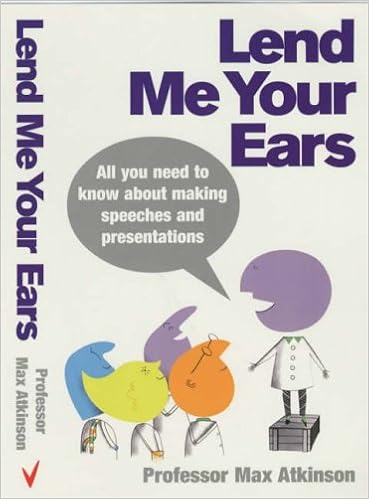
2. Twenty years later, after making a living putting into practice the basic principles – i.e. by running hundreds of courses and coaching lindividuals in private and public sectors (+ a few politicians) I wrote a ‘how to do it’ book. This time I was lucky to have a literary agent, Bill Hamilton of AM Heath & Co who understood how to write for different audiences. He taught me how to “address the reader directly.” Without my realising it, a legacy of academic writing was that I was still tending to write in the third person “if a speaker does this… “. Bill suggested I try writing “if you do this….”
His other main piece of advice was that I shouldn’t be afraid of using shortened or elided forms (“don’t” rather than “do not”. etc.) – which as an academic, I’d never have thought of doing. So I went through the original manuacript and, wherever possible changed the text as he’d suggested. At the end of the exercise, I was frankly amazed at how much more ‘readable’ it had made the book.
3. Peter Semper, an old school-friend, was very positive about Lend me your Ears though he did have a ‘but’: “only thing wrong with it is that it’s far too long for business people like me to read on a train or a flight - so why don’t you do a shorter version aimed at us." After a reasonably favourable response from my agent and publishers my agent and publishers, I asked Peter to have a go at producing a shorter version.
Fairly quickly, he sent me a copy of what he’d produced and, thanks to the wonders of word-processing technologly, I could see instantly that he’d only managed to cut it down by about a third – which I didn’t think was enough. So I set about cutting out even more and managed to get rid of another third. The result was Speechmaking and Presentation Made Easy: Seven essential steps to success:
4. During the Labour Party’s annual conference in September 2008, Michael Crick (then political editor of BBC TV’s Newsnight, now on Channel 4 News) suggested that I should start a blog. In June 2009, I reached my 250th blog-post. and realised that it was becoming something of an obsession.
The good news was that it was being favourably received. As Ayd Instone notes in his foreword to this next book (p. 7): “Politics.co.uk awarded it the same score (8/10) as Iain Dale’s Diary, one of the country’s top rated blogs. In their review, they said “Not many blogs out there focus so much on politicians’ presentation styles, so this makes a nice addition…a thoroughly impressive piece of work.”
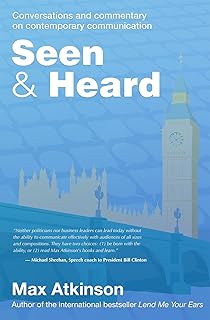
At which point, I should confess that I personally find reading a book or newspaper easier and more satisfying than reading stuff from a screen, which is why the idea of publishing an edited collection of my blog-posts from 2008-2014 appealed to me. The result was:
Seen & Heard: conversations and commentary on contemporary communication
I found today's news as especially sad, not just because I was a Leeds fan when the young Jack was playing for 2nd division Leeds United (while younger brother 'our kid' Bobby played for 1st division Manchester United), but because this talented player (and manager) appears to have been yet another victim of dementia caused by heading footballs
In 2017, a BBC TV documentary Dementia, Football and Me (https://www.bbc.co.uk/sport/football/41902953) presented by Alan Shearer looked at the impact of heading footballs on the brain - and ultimately on players developing dementia. When watching Shearer heading a ball numerous times, I thought it all very well, but when people quite a lot older than him played football, the balls were made of leather, which meant that they got extremely heavy in wet weather (i.e. for most of the football season).
What 's so depressing about the death of Jack Charlton is that he's by no means the only one of the 1966 team to have suffered from dementia. He lasted until he was 83, as did Ray Wilson who also died of it. Martin Peters succombed to it at 76, while manager and former full-back Sir Alf Ramsey died of it at 79. Nobby Stiles (78) is still alive but has advanced dementia.
This adds up to 42% of those directly involved in our winning the world-cup in 1966 falling victim to dementia. I'm hopeless at statistics, but would say that this must surely be statistically very significant.
(An excellent film about Jack Charlton from today's BBC archive can be seen at
The front page of today's I Newspaper has an interesting headline::
Beneath the headline, it says: Exclusive 76% of people think lockdown imposed too late, new polling suggests >> Prime Minister's approval rating collapses from +38% to -7% in two months >> 55% say the Government has not handled crisis well with 32% supportive >> Uk alert level downgraded, allowing ministers to further ease lockdown >> Scientists warn against complacency's R rate remains stubbornly close to 1 See P6
On page 6, the headline is 'Johnson's approval ratings in the red' above a picture of the PM scratching his head at a primary school yesterday.
And a fascinating letter from the editor, Oliver Duff on page 3 is headlined: PM's pivotal moment
Todays i newspaper has an excellent, if rather depressing, analysis of recent political events involving our P.M and his beloved aide by one of the paper's leading columnists, Ian Birrel:
Boris Johnson relies on Dominic
Cummings as a comfort blanket because he has few ideas of his own
The Prime Minister's pathetic
appearance at the Commons Liaison Committee shows that he is a hollow, shallow
Prime Minster
Clearly Dominic Cummings has
little respect for rules. So he must be delighted to have shattered one of the
most oft-heard maxims in Westminster: when an adviser becomes the story, they
must go.
Never mind that he has been
exposed as a fraud – the populist who believes he can behave differently to
lesser folk; the data guru unaware changing a blog could be easily detected;
the “superforecaster” who failed to see the furore.
Nor indeed that the entire nation
could observe the pomposity being pricked of a man who sneers at many other
mortals, squirming to keep his job with an absurd story about driving to test
his eyesight.
This diminished character stays
in Downing Street to serve as a perpetual symbol of the political elite he
claimed to despise. His behaviour has reinforced the most corrosive image for
the Conservatives as a party out of touch with ordinary people. The furore
could not have come at worse time for his boss as questions arise over the
Government’s dire response to deadly pandemic. The big question is why was
Boris Johnson so desperate to retain his toxic pal in defiance of much of his
party and the public?
There are a slew of suggested
answers. Johnson has long been a rule breaker in both his personal and
professional life. He dislikes lockdown as someone intuitively sceptical about
the state (almost certainly one reason Britain was fatally slow in its response
to the virus). Like every incoming prime minister, he is determined not to be
pushed around by the media. These are valid explanations. The key reason,
however, was exposed when Johnson was forced to finally appear for a grilling
by the Commons Liaison Committee.
We know the Prime Minister is a
politician who tries to evade tough questioning. This 100-minute session showed
the reason for his reluctance. From start to finish, Johnson was floundering –
repeating mantras such as the need to “move on” from the Cummings farce,
waffling almost incoherently, woefully sluggish in reply to tough questions,
admitting he did not read scientific advice “except in exceptional
circumstances”, and, most alarmingly, lacking grasp of basic political detail.
Dodging questions over Cummings
was demeaning but predictable. Johnson was also fortunate some interrogators
sought to grandstand rather than probe. But when urged, for instance, to help
hitherto overlooked self-employed workers reliant on dividend payments from
their own firms – which the Tory MP Mel Stride rightly called a gaffe in the
strong fiscal response to pandemic – Johnson ended up boasting about “a pretty
awesome package”.
Darren Jones then raised issues
on the self-employed income support scheme, only to be met with blathering
about “generous” universal credit. “Prime minister, universal credit is not
generous,” the Labour MP replied acidly.
There were several more
toe-curling moments. Caroline Nokes, chair of the equalities committee, fired
off a series of strong questions on childcare and female representation in
decision-making. First came some flannel about female advisers. Then Johnson
patronisingly told a woman he fired from senior ministerial office that she
might end up the third Tory prime minister. Finally he had to be reprimanded
for laughing by the chair with a warning that gender equality was “not a joking
matter”.
Mostly it was rather pitiful,
like watching a talentless comedian wilt on stage. Yet one moment was terrible.
Labour’s Stephen Timms raised the case of a struggling couple in his London
consistency with leave to remain in the country but no recourse to public
funds. “Hang on,” he replied. “Why aren’t they eligible for universal credit or
employment support allowance or any of the other benefits?”
Bear in mind this is a politician
who won highest office at the helm of a movement exploiting fear over foreign
workers. He has given speeches about migrants treating Britain “as their own
country”. He plans to reform the immigration system to make it “fairer”. Yet he
was baffled when asked about a key plank of policy introduced in the last
century, extended by the Tories and debated dozens of times in Parliament.
Alarmingly, Johnson claimed to
have prepared. He was trying to be on his best behaviour. The questions were
not even that tricky. Yet he ended up showing that while he can be an engaging
and witty performer of set pieces, he lacks many skills demanded of a top
politician – from verbal dexterity, beyond mumbling and bumbling, through to a
firm grasp of detail and policy. Perhaps this should not be a surprise. The
broadcaster Jeremy Vine revealed how much of his act is based on artifice after
seeing two identical speeches with the same messed-up hair and gags. But it is
depressing to witness in a prime minister, especially amid a pandemic.
For all his showboating success
in winning elections, Johnson has a poor record in office. As mayor he rode the
coat-tails of his predecessor, his landmark policy of a garden bridge turning
into a costly flop. As foreign secretary, his inattention to detail was
disastrous. As prime minister, he seems to have no driving cause beyond a
hollow brand of patriotism and self-preservation. So it is obvious why he wants
the comfort blanket of a trusted aide who poses as someone with bold solutions.
But Britain faces extremely
challenging times. A pandemic is raging. People are dying. Flaws in society lie
brutally exposed. We face a savage economic downturn, possibly the worst for
three centuries. Now we have seen again, harshly exposed in the spotlight of
parliamentary accountability, the person in charge of our country. It is not a
reassuring image.


![Speech-making and Presentation Made Easy: Seven Essential Steps to Success by [Max Atkinson]](https://m.media-amazon.com/images/I/51MS5AYt2yL.jpg)