PM wants to "build a new Jerusalem"

Listening to Boris Johnson's leader's speech at the Tory party conference today meant that you had to put up with an elementary guide to rhetoric for beginners and a mass of corny old clichés

Behind him was the 3 parted alliterative multi-coloured slogan: BUILD BACK BETTER


Johnson also want's to "build a new Jerusalem" and, if you think it's going to echo William Blake (i.e. do it in England's 'green and pleasant land') the speech claimed that he's discovered green energy too!

Even The Guardian seems to have been quiteimpressed: 

"Boris Johnson has said in his speech to the Conservative party conference that Britain must not return to the status quo after the coronavirus pandemic, promising a transformation akin to the 'New Jerusalem' the postwar cabinet pledged in 1945. The prime minister also mounted a robust defence of the private sector, saying 'free enterprise' must lead the recovery and that he intended to significantly roll back the extraordinary state intervention that the crisis had necessitated."

What I'd like to know is who writes this kind of garbage? 

After all, every Tory's heroine Margaret Thatcher took the business of speaking rather more seriously, she relied on some brilliant writers and she rehearsed. Does Johnson think that, as a former president of the Oxford Union debating society, he doesn't need to bother?


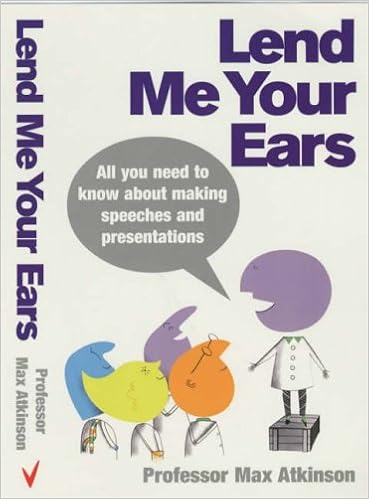
BOOKS BY Max Atkinson on public speaking, presentation and communication

Twitter, it seems, is widely used by authors to advertise their own books – as too are various programmes on BBC Radio 4. Yesterday’s Start the Week, for example was presented by Andrew Marr, who gave two authors who gave each of them about 45 minutes to plug their latest books. One, was former Archbishop of Canterbury Dr Rowan Williams (whose sermons sometimes included 150 word sentences that were unintelligible to listeners). In retirement, he’s become master of a Cambridge college and has just written a book in St. Benedict. I didn’t bother to check the length of his sentences but can report that he hasn’t changed and I shall not be buying his book.

1. Having written quite a few academic books, my first attempt at writing for a wider public was based on research that I’d done (while fellow of an Oxford college) into audience responses to political speeches. Originally published by Methuen in 1984, it’s still in print (thanks to Routlege).

Reading it now, I don’t think I got the hang of writing for a non-academic audience until Chapter 3. Claptrap – which was also used by Granada Television as the title of the World in Action documentary based on findings reported in the book that you can watch on the opening page of my website at speaking.co.uk

 by Max Atkinson (Author) 4.7 out of 5 stars 5 ratings

 See all formats and editions Paperback 
£23.18 
9 Used from £4.974 New from £17.50

2. Twenty years later, after making a living putting into practice the basic principles – i.e. by running hundreds of courses and coaching lindividuals in private and public sectors (+ a few politicians) I wrote a ‘how to do it’ book.  This time I was lucky to have a literary agent, Bill Hamilton of AM Heath & Co who understood how to write for different audiences. He taught me how to “address the reader directly.” Without my realising it, a legacy of academic writing was that I was still tending to write in the third person “if a speaker does this… “. Bill suggested I try writing  “if you do this….” 

His other main piece of advice was that I shouldn’t be afraid of using shortened or elided forms (“don’t” rather than “do not”. etc.) – which as an academic, I’d never have thought of doing. So I went through the original manuacript and, wherever possible changed the text as he’d suggested. At the end of the exercise, I was frankly amazed at how much more ‘readable’ it had made the book.


by Max Atkinson  (Author) 4.6 out of 5 stars 49 rating

£11.55 23 Used from £1.415 New from £10.24

 See all formats and editions

3. Peter Semper, an old school-friend, was very positive about Lend me your Ears though he did have a ‘but’: “only thing wrong with it is that it’s far too long for business people like me to read on a train or a flight - so why don’t you do a shorter version aimed at us." After a reasonably favourable response from my agent and publishers my agent and publishers, I asked Peter to have a go at producing a shorter version.

Fairly quickly, he sent me a copy of what he’d produced and, thanks to the wonders of word-processing technologly, I could see instantly that he’d only managed to cut it down by about a third – which I didn’t think was enough. So I set about cutting out even more and managed to get rid of another third.  The result was Speechmaking and Presentation Made Easy: Seven essential steps to success:

Look inside this book.
Speech-making and Presentation Made Easy: Seven Essential Steps to Success by [Max Atkinson]

£9.99

3.9 out of 5 stars 

7 ratings

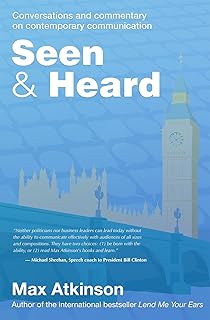
4. During the Labour Party’s annual conference in September 2008, Michael Crick (then political editor of BBC TV’s Newsnight, now on Channel 4 News) suggested that I should start a blog. In June 2009, I reached my 250th blog-post. and realised that it was becoming something of an obsession. 

The good news was that it was being favourably received. As Ayd Instone notes in his foreword to this next book (p. 7): “Politics.co.uk awarded it the same score (8/10) as Iain Dale’s Diary, one of the country’s top rated blogs. In their review, they said “Not many blogs out there focus so much on politicians’ presentation styles, so this makes a nice addition…a thoroughly impressive piece of work.”

At which point, I should confess that I personally find reading a book or newspaper easier and more satisfying than reading stuff from a screen, which is why the idea of publishing an edited collection of my blog-posts from 2008-2014 appealed to me. The result was: 

Seen & Heard: conversations and commentary on contemporary communication

in politics, the media and around the world

Seen & Heard: Conversations and commentary on contemporary conversation

Paperback: £10.99

Kindle Edition £3.72

5.0 out of 5 stars 

4 ratings

Kindle Edition£3.72 

Jack Charlton, Leeds United & England, R.I.P.

I found today's news as especially sad, not just because I was a Leeds fan when the young Jack was playing for 2nd division Leeds United (while younger brother 'our kid' Bobby played for 1st division Manchester United), but because this talented player (and manager) appears to have been yet another victim of dementia caused by heading footballs

In 2017, a BBC TV documentary Dementia, Football and Me (https://www.bbc.co.uk/sport/football/41902953) presented by Alan Shearer looked at the impact of heading footballs on the brain - and ultimately on players developing dementia. When watching Shearer heading a ball numerous times, I thought it all very well, but when people quite a lot older than him played football, the balls were made of leather, which meant that they got extremely heavy in wet weather (i.e. for most of the football season).

What 's so depressing about the death of Jack Charlton is that he's by no means the only one of the 1966 team to have suffered from dementia. He lasted until he was 83, as did Ray Wilson who also died of it. Martin Peters succombed to it at 76, while manager and former full-back Sir Alf Ramsey died of it at 79. Nobby Stiles (78) is still alive but has advanced dementia.

This adds up to 42% of those directly involved in our winning the world-cup in 1966 falling victim to dementia. I'm hopeless at statistics, but would say that this must surely be statistically very significant.

(An excellent film about Jack Charlton from today's BBC archive can be seen at
https://www.bbc.co.uk/sport/football/53373542).


PUBLIC GIVES JOHNSON THUMBS-DOWN

The front page of today's I Newspaper has an interesting headline::


Beneath the headline, it says:

Exclusive 76% of people think lockdown imposed too late, new polling
 suggests

>> Prime Minister's approval rating collapses from +38% to -7% in two months

>>  55% say the Government has not handled crisis well with 32% supportive

>> Uk alert level downgraded, allowing ministers to further ease lockdown

>> Scientists warn against complacency's R rate remains stubbornly close to 1

                                                                                        See P6


On page 6, the headline is 'Johnson's approval ratings in the red' above a picture of the PM scratching his head at a primary school yesterday.

And a fascinating letter from the editor, Oliver Duff on page 3 is headlined: PM's pivotal moment

Johnson a hollow, shallow PM and Cummings isn't going


Todays i newspaper has an excellent, if rather depressing, analysis of recent political events involving our P.M and his beloved aide by one of the paper's leading columnists, Ian Birrel:

Boris Johnson relies on Dominic Cummings as a comfort blanket because he has few ideas of his own

The Prime Minister's pathetic appearance at the Commons Liaison Committee shows that he is a hollow, shallow Prime Minster

Clearly Dominic Cummings has little respect for rules. So he must be delighted to have shattered one of the most oft-heard maxims in Westminster: when an adviser becomes the story, they must go.

Never mind that he has been exposed as a fraud – the populist who believes he can behave differently to lesser folk; the data guru unaware changing a blog could be easily detected; the “superforecaster” who failed to see the furore.

Nor indeed that the entire nation could observe the pomposity being pricked of a man who sneers at many other mortals, squirming to keep his job with an absurd story about driving to test his eyesight.

This diminished character stays in Downing Street to serve as a perpetual symbol of the political elite he claimed to despise. His behaviour has reinforced the most corrosive image for the Conservatives as a party out of touch with ordinary people. The furore could not have come at worse time for his boss as questions arise over the Government’s dire response to deadly pandemic. The big question is why was Boris Johnson so desperate to retain his toxic pal in defiance of much of his party and the public?

There are a slew of suggested answers. Johnson has long been a rule breaker in both his personal and professional life. He dislikes lockdown as someone intuitively sceptical about the state (almost certainly one reason Britain was fatally slow in its response to the virus). Like every incoming prime minister, he is determined not to be pushed around by the media. These are valid explanations. The key reason, however, was exposed when Johnson was forced to finally appear for a grilling by the Commons Liaison Committee.

We know the Prime Minister is a politician who tries to evade tough questioning. This 100-minute session showed the reason for his reluctance. From start to finish, Johnson was floundering – repeating mantras such as the need to “move on” from the Cummings farce, waffling almost incoherently, woefully sluggish in reply to tough questions, admitting he did not read scientific advice “except in exceptional circumstances”, and, most alarmingly, lacking grasp of basic political detail.

Dodging questions over Cummings was demeaning but predictable. Johnson was also fortunate some interrogators sought to grandstand rather than probe. But when urged, for instance, to help hitherto overlooked self-employed workers reliant on dividend payments from their own firms – which the Tory MP Mel Stride rightly called a gaffe in the strong fiscal response to pandemic – Johnson ended up boasting about “a pretty awesome package”.


Darren Jones then raised issues on the self-employed income support scheme, only to be met with blathering about “generous” universal credit. “Prime minister, universal credit is not generous,” the Labour MP replied acidly.

There were several more toe-curling moments. Caroline Nokes, chair of the equalities committee, fired off a series of strong questions on childcare and female representation in decision-making. First came some flannel about female advisers. Then Johnson patronisingly told a woman he fired from senior ministerial office that she might end up the third Tory prime minister. Finally he had to be reprimanded for laughing by the chair with a warning that gender equality was “not a joking matter”.

Mostly it was rather pitiful, like watching a talentless comedian wilt on stage. Yet one moment was terrible. Labour’s Stephen Timms raised the case of a struggling couple in his London consistency with leave to remain in the country but no recourse to public funds. “Hang on,” he replied. “Why aren’t they eligible for universal credit or employment support allowance or any of the other benefits?”

Bear in mind this is a politician who won highest office at the helm of a movement exploiting fear over foreign workers. He has given speeches about migrants treating Britain “as their own country”. He plans to reform the immigration system to make it “fairer”. Yet he was baffled when asked about a key plank of policy introduced in the last century, extended by the Tories and debated dozens of times in Parliament.


Alarmingly, Johnson claimed to have prepared. He was trying to be on his best behaviour. The questions were not even that tricky. Yet he ended up showing that while he can be an engaging and witty performer of set pieces, he lacks many skills demanded of a top politician – from verbal dexterity, beyond mumbling and bumbling, through to a firm grasp of detail and policy. Perhaps this should not be a surprise. The broadcaster Jeremy Vine revealed how much of his act is based on artifice after seeing two identical speeches with the same messed-up hair and gags. But it is depressing to witness in a prime minister, especially amid a pandemic.

For all his showboating success in winning elections, Johnson has a poor record in office. As mayor he rode the coat-tails of his predecessor, his landmark policy of a garden bridge turning into a costly flop. As foreign secretary, his inattention to detail was disastrous. As prime minister, he seems to have no driving cause beyond a hollow brand of patriotism and self-preservation. So it is obvious why he wants the comfort blanket of a trusted aide who poses as someone with bold solutions.

But Britain faces extremely challenging times. A pandemic is raging. People are dying. Flaws in society lie brutally exposed. We face a savage economic downturn, possibly the worst for three centuries. Now we have seen again, harshly exposed in the spotlight of parliamentary accountability, the person in charge of our country. It is not a reassuring image.


Parole: the legacy of a progressiveHome Secrtary

As murders by terrorists recently released from prison hit the headlines a few weeks ago,  I was reminded of my first job after graduating in 1965 - as a lowly assistant research officer at the Home Office Research Unit.

There was excitement in the air with a new Labour government and prime minister Harold Wilson's appointment of Roy Jenkins as Home Secretary. Jenkins' aim was to build "a civilised society", with measures like the ab olition of capital punishment and theatre censorship, the partial decriminalisation of homosexuality, relaxation of divorce law, suspension of birching and the liberalisation of abortion law.

Jenkins also began to think about introducing parole. At the time, some of us in the Research Unit were working on the nearest equivalent at the time: the prison hostel scheme. Our job was to attend, observe and assess the monthly hostel board meetings in D wing at HM prison, Wormwood Scrubs, where prisoners serving from 5 years to life sentences (including KGB spy George Blake who was five years into his 42 year sentence - we were scheduled to, but didn't, attend on the day he escaped).

It was called the 'prison hostel scheme' because, for the last six months before their date of release, they could treat the prison as a hostel from which they would go out to work in paid employment. It was, in other words, a very innovative rehabilitation scheme and the nearest thing to parole that existed at the time.

After attending and observing quite a lot of hostel-selection board meetings, my research came up with an interesting result. The chances of those  selected for the hostel-scheme within three years would have been better had the chairman of the selection-committee spun a coin instead of presiding over several hours 'carefully dicussing' every application with the eight other people at the meeting.

The reason was that the committee liked inmates who were professional criminals like thieves, house-breakers, burglars and robbers. They did not like white-collar inmates like fraudsters or sex-offenders and were ambivalent about lifers serving sentences for murder. So they systematically granted places on the scheme to those who were by far the most likely to reoffend within three yease of release.

Although I wrote a report explaining all this, I doubt if it ever got as far as the Home Secretary who opted for parole-selection boards thar were very similar in composition to hostel-selection boades.

Boris Johnson: 'The boy who wanted to be king.


At next week's European Speechwriters conference in Paris, Brian Jenner has asked me to run a breakout session on the afternoon of Friday 27th September - where the probable topic is the rhetorical skill (or otherwise) of new UK prime minister Johnson.

I'd strongly recommend anyone thinking of attending the session watches the above 10 minute interview with Michael Cockerell on BBC Newsnight, as it's one of the most revealing programmes about him that I've seen (and includes some early footage of the young Johnson as president of the Oxford Union Debating society).

Which living UK PMs weren't at yesterday's memorial service for Paddy Ashdown?

Yesterday, I was one of the 2,000 people who assembled in Westminster Abbey for 'A Service of Thanksgiving for the life and work of the Right Honourable the Lord Ashdown of Norton-sub-Hamdon KCMG CH KB 1941-2018':


Of the six living UK prime ministers, four were there (see below) - one of whom, John Major, gave an excellent address. But Theresa May and Boris Johnson were not there. 

When Paddy died last December, Mrs May said that he had "served this country with distinction" and "had dedicated his life to public service and he will be sorely missed." She was. of course, right. But an internet search reveals that our current journalist PM neither said nor wrote anything about this unexpected death that took everyone by surprise. And one can only assume that he was far too busy yesterday (consulting lawyers at our expense?) to be bothered to join the many other politicians and journalists who were there.

Left to right: Gordon Brown, Tony Blair, David Cameron, John Major
Apart from current and former LibDem MPs and peers, other from Westminster's great and the good who were there included Speakers John Bercow and Norman Fowler, Chris Patten, Shami Chakrabati, Peter Mandelson, Ken Clarke and Michael Heseltine.

In other words, reps from different parties - but quite a few of the Tory elder statesmen have been sacked by Johnson and his Brexiteer cabinet cronies. 

So not at all surprising that our Etonion-Oxford-educated PM didn't have the manners to show up yesterday. If I'd had the money to pay to educate my children so expensively, I'd ask Eton and Balliol for my money back....


Johnson's professional media manipulators


On 19th August, The New European published the following:
Boris Johnson's new advisers are urging ministers to avoid Radio 4'sToday programme as they believe the programme is a 'total waste of time'.
According to the Mail on Sundaythe new director of communications at Downing Street Lee Cain has advised his colleagues to stop putting up ministers to appear on the programme.
The proposal has the support of Dominic Cummings who is reported to have declared last week: "I never listened to the Today programme for the entire year of the referendum and I intend to repeat this while I am here." 
He said not to put ministers forward "unless they change format and actually start exploring serious subjects in a serious way".
During Boris Johnson's leadership campaign the only interviews he gave were with Sky News' Sophy Ridge and the BBC's Laura Kuenssberg.
He refused to give an interview to Radio 4's Today programme, instead turning up briefly on the station's World at  One.
___________________________________

Anyone curious to know more about Messrs. Cain and Cummings (for whom as taxpayers we are all paying) need look no further than Wikipedia which tells us about both of them:
Lee Cain is a British journalist and government appointee who currently serves as Downing Street Director of Communications under Boris Johnson. Cain was appointed by Johnson on 24 July 2019...
Prior to his appointment, Cain worked as Head of Broadcast for the Vote Leave campaign, in addition to serving at the Department for Environment, Food and Rural Affairs under Andrea Leadsom and Michael Gove. He briefly worked for Theresa May before leaving to work with Johnson while he was serving as Secretary of Stated for Foreign and Commonwealth Affairs, Cain's former employer, The Daily Mirror has stated that was deployed to taunt former Prime Minister David Cameron and other Conservative MPs dressed as a chicken.

Dominic Cummings born 25 November 1971) is a British political strategist. From 2007 to 2014 he was a special adviser to the then Education Secretary, Michael Gove. In 2015–16 he was the campaign director of Vote Leave, an organization opposed to continued UK membership of the European Union and which took an active part in the 2016 referendum campaign on the subject. In July 2019 the new Prime Minister, Boris Johnson, Prime Ministerappointed him to the role of special adviser to the government.

______________________________

If you were surprised by Johnson's  willingness  to pick a cabinet so full of hard-line brexiteers, his selection of hardline brexiteer backroom boys is not surprising but totally predictable. It's not just that they were both deeply involved in the Vote Leave campaign, but Cain subsequently worked for other leading brexiteers like Leadsom and Gove.

Has our esteemed PM forgotten that his government has a majority of ONE - and that there are plenty of Tory MPs who are still keen remainers and/or opposed to leaving the EU without a deal?